


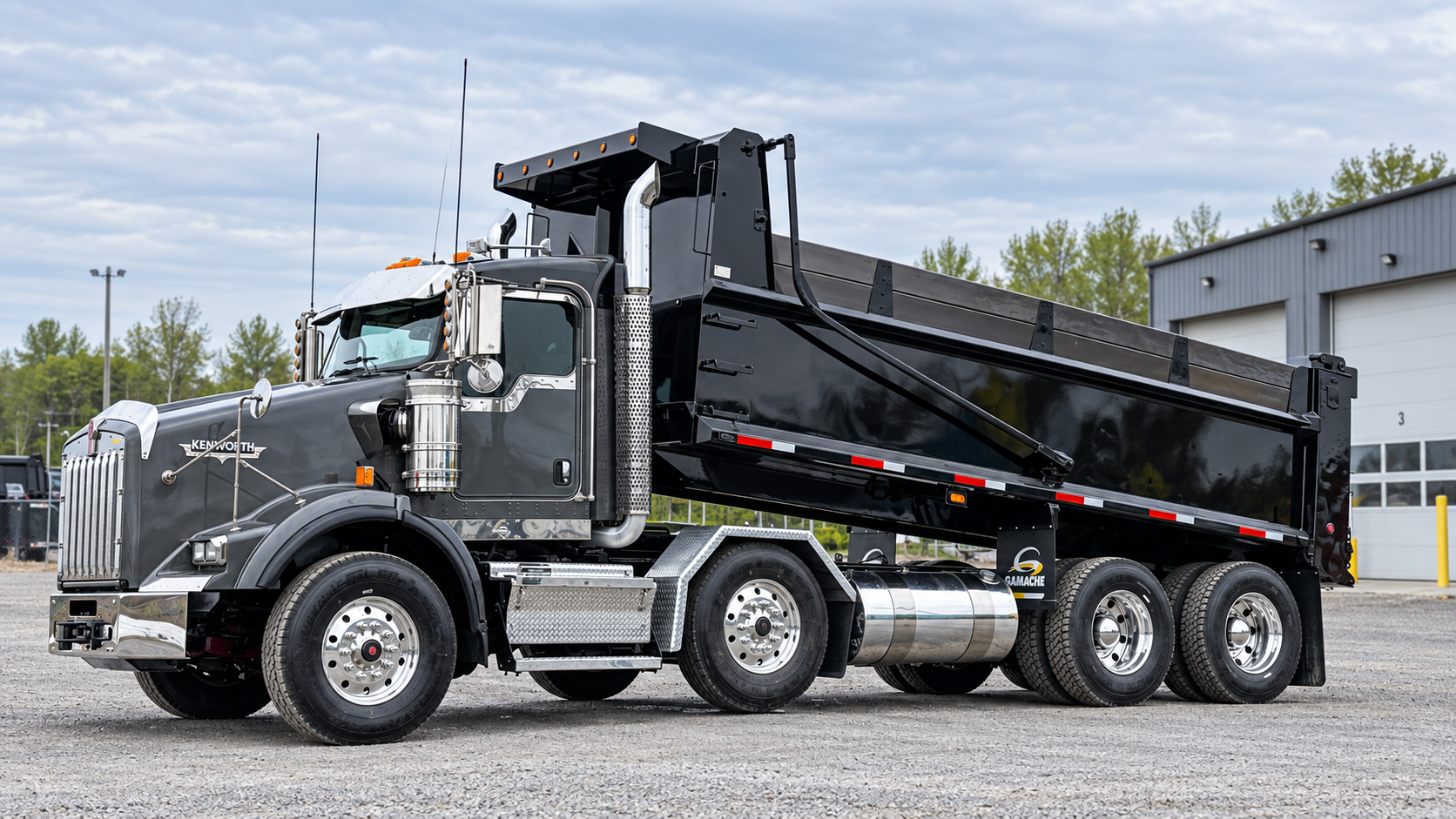
A lift axle on a heavy-duty truck is designed to help distribute weight when the vehicle is loaded and to lift off the road when it is not required. This type of auxiliary axle is common on dump trucks, vocational trucks and many specialized commercial vehicles.
However, there is considerable confusion surrounding the terms lift axle, tag axle, pusher axle and SPIF. They do not all describe the same thing. A lift axle is defined by how it operates, while tag and pusher describe where the axle is positioned. SPIF, meanwhile, refers to an Ontario regulatory framework that applies to the vehicle’s complete configuration.
Before buying a used heavy-duty truck, it is essential to understand the axle’s actual role, capacity and condition, as well as the regulations that apply wherever the truck will operate.
What is a lift axle on a heavy-duty truck?
A lift axle is a non-driven auxiliary axle that can be lowered to carry part of the vehicle’s weight or raised when it is not needed. Depending on the truck, the mechanism may use an air or hydraulic system.
When the axle is lowered, part of the truck’s weight rests on its wheels, distributing the load across more axles. When the truck is empty or lightly loaded—and regulations allow it—the axle can be raised so its tires no longer contact the road.
What does a lift axle do?
- Distributes the weight of the truck and its load across more axles
- Helps the vehicle comply with applicable axle and axle-group weight limits
- Allows the truck to adapt to changing loads
- Reduces unnecessary tire wear when the axle can legally be raised
- May improve manoeuvrability by shortening the truck’s effective wheelbase
The presence of a lift axle does not automatically mean that a truck can legally carry a heavier load. Allowable weight depends on the entire configuration, including axle count and spacing, tire and suspension capacities, weight ratings, road type, and provincial or state regulations.
SPIF vs. tag axle vs. lift axle: what is the difference?
| Term | What it describes | Key characteristic |
|---|---|---|
| Lift axle | How the axle operates | An auxiliary axle that can be raised or lowered |
| Tag axle | Where the axle is positioned | An auxiliary axle located behind the drive axles |
| Pusher axle | Where the axle is positioned | An auxiliary axle located ahead of the drive axles |
| SPIF | Compliance of an Ontario vehicle configuration | Standards involving weight, dimensions, axle spacing and equipment |
These terms can overlap. An axle located behind the drive axles that can be raised is both a tag axle and a lift axle. If it is part of a vehicle configuration that meets the applicable Ontario requirements, it may also be part of a SPIF-compliant truck.
What is a tag axle?
A tag axle is an auxiliary axle located behind the drive axle or drive-axle group. Its position helps support weight toward the rear of the chassis. Depending on the configuration, a tag axle may be fixed, liftable, steerable or self-steering. The word tag alone does not mean that the axle can be lifted.
What is a pusher axle?
A pusher axle is installed ahead of the drive axles. It also helps distribute the load. If it has a lifting mechanism, it is both a pusher axle and a lift axle. Its position can affect weight distribution between the front and rear of the truck differently than a tag axle.
Is a SPIF axle a specific type of axle?
Not exactly. SPIF stands for Safe, Productive, Infrastructure-Friendly. The term refers to Ontario’s regulatory framework under Ontario Regulation 413/05: Vehicle Weights and Dimensions.
In the trucking industry, “SPIF axle” is often used as shorthand. Technically, it is more accurate to describe an axle as part of a SPIF-compliant configuration. Compliance cannot be confirmed simply by looking at one axle. It depends on the complete vehicle, including its dimensions, axle spacing, model year and equipment.
Note: the correct abbreviation is SPIF, not “spiff.” The misspelling sometimes appears in online searches and classified listings, but it is not the official name of the Ontario framework.
Which trucks use lift axles?
Lift axles are most common on trucks with changing loads or configurations that require weight to be distributed across several points of contact. They are often found on:
- dump trucks;
- concrete mixer trucks;
- crane trucks;
- vacuum and hydrovac trucks;
- flatbed trucks;
- certain refuse, construction and specialized transport trucks.
This configuration is especially common on used dump trucks, because their payload can be substantial and vary from one trip to the next.
Why can a self-steering axle be beneficial?
A self-steering axle allows the wheels to follow the truck’s path more naturally through a turn. This can reduce tire scrubbing, improve vehicle tracking and limit stress on the road and certain components. However, it also adds parts that must be inspected, including kingpins, bushings, shock absorbers and the locking system.
Benefits of a lift axle
Better load distribution
Lowering the axle spreads weight across more wheels and support points. Proper load distribution helps prevent a single axle or axle group from carrying excessive weight.
Less wear when the axle is not needed
When the truck is empty or light enough—and the applicable rules allow the axle to be raised—its tires no longer contact the road. This can reduce tire wear and the rolling resistance created by the additional wheels.
An adaptable configuration
A truck carrying variable loads can adjust the number of axles on the ground to suit its operating conditions. This flexibility is valuable for businesses that alternate between job sites, loaded deliveries and empty return trips.
Potentially better manoeuvrability
Raising an axle may shorten the effective wheelbase and make certain manoeuvres easier. The exact effect depends on the axle’s location, the chassis and the type of steering system.
Limitations and points to consider
- Added weight: the axle, suspension and control system increase the truck’s empty weight.
- Additional maintenance: air bags, valves, lines, kingpins, brakes and lifting mechanisms require maintenance.
- Improper load distribution: incorrect pressure or adjustment can overload the other axles.
- Tire wear: a misaligned, poorly calibrated or non-steering axle can cause scrubbing and uneven wear.
- Different regulations: requirements vary by province, state, road and vehicle configuration.
The tires must also have the correct load rating and show even wear. Browse Centre du Camion Gamache’s inventory of heavy-duty truck tires if replacement tires are required.
Seven checks before buying a truck with a lift axle
1. Confirm the axle’s position and type
Determine whether it is a tag axle behind the drive axles or a pusher axle ahead of them. Also confirm whether the axle is fixed, liftable, steerable or self-steering.
2. Test the lifting mechanism
Lower and raise the axle. The movement should be smooth. Inspect the air bags, lines, valves, brackets and controls for leaks, damage or irregular operation.
3. Examine the tires and alignment
Cupping, wear on only one side, or major differences from one tire to another may indicate an alignment, pressure or load-sharing problem.
4. Inspect the brakes, hubs and bearings
Depending on the configuration, a lowered auxiliary axle must contribute to braking. Check the drums or discs, brake chambers, lines, hubs and bearings.
5. Compare all rated capacities
The axle rating must be compatible with the capacities of the suspension, tires, wheels, brakes and chassis. The lowest-rated component may limit the complete system.
6. Check axle spacing and vehicle dimensions
Axle count alone is not enough to calculate the allowable load. The spacing between axles and the vehicle’s dimensions play an essential role in determining the applicable limits.
7. Verify the documents and operating territory
If the truck will operate in Ontario, request the information needed to confirm its SPIF configuration. For Quebec operations, verify Quebec’s requirements. A truck travelling through several provinces or states may be subject to different limits in each jurisdiction.
How do you choose the right axle configuration?
The right choice depends on the work the truck will actually perform. Before comparing vehicles, identify:
- the material or equipment being transported;
- the typical and maximum loads;
- the provinces or states where the vehicle will operate;
- the frequency of empty return trips;
- turning and job-site access constraints;
- whether a self-steering axle is required;
- the acquisition and maintenance budget.
Truck and heavy-equipment financing can also be included in the total acquisition-cost analysis. A more specialized configuration may cost more initially but be better suited to the operation and the loads being carried.
Find a truck with a lift axle at Centre du Camion Gamache
Choosing a truck with a lift axle should never be based only on the words “lift axle” or “SPIF” in a listing. The complete vehicle, its condition, axle spacing, rated capacities and intended operating territory must all be evaluated.
Centre du Camion Gamache offers a large selection of used heavy-duty trucks for sale, including vocational and dump trucks equipped with auxiliary axles. Our inventory listings make it easier to compare key specifications, and our team can help you find a unit suited to your operation.
Already have a model in mind? Contact Centre du Camion Gamache to confirm its availability and obtain complete configuration details.
Frequently asked questions about lift axles
What is the difference between a lift axle and a tag axle?
A lift axle is defined by how it operates: it can be raised or lowered. A tag axle is defined by its position behind the drive axles. A tag axle can therefore also be a lift axle if it has a lifting mechanism.
What is the difference between a tag axle and a pusher axle?
A tag axle is positioned behind the drive axles, while a pusher axle is positioned ahead of them. Both are auxiliary axles, and either may be liftable depending on the truck’s configuration.
Is a SPIF axle a type of lift axle?
No. SPIF is not a mechanical axle type. It is an Ontario regulatory framework that applies to certain vehicle configurations. A lift axle can be part of a SPIF-compliant configuration, but compliance depends on the complete vehicle.
Does a lift axle always allow a truck to carry more weight?
No. It helps distribute the load, but legal weight depends on axle count and spacing, the vehicle’s technical capacities and the rules in effect where it operates.
Can you drive with a lift axle raised?
Only when the load and applicable regulations allow it. If the axle is needed to meet a weight limit or configuration requirement, it must be lowered and share the load correctly.
Which trucks most commonly use lift axles?
Lift axles are commonly found on dump trucks, concrete mixers, crane trucks, vacuum trucks, flatbeds and many vocational or specialized vehicles.
What should you inspect on a used lift axle?
Inspect the lifting mechanism, air bags, lines, valves, controls, tires, alignment, brakes, hubs, bearings, kingpins and chassis mounting points.
Do Ontario’s SPIF standards apply in Quebec?
SPIF is an Ontario framework. In Quebec, the truck must comply with Quebec’s weight and dimension rules. A vehicle operating in several jurisdictions must meet the applicable requirements in each one.
The information provided is general in nature. Weight, dimension and equipment requirements vary by vehicle, road and jurisdiction. Have the exact configuration and current regulations confirmed by the appropriate authority before placing the truck into service.


