


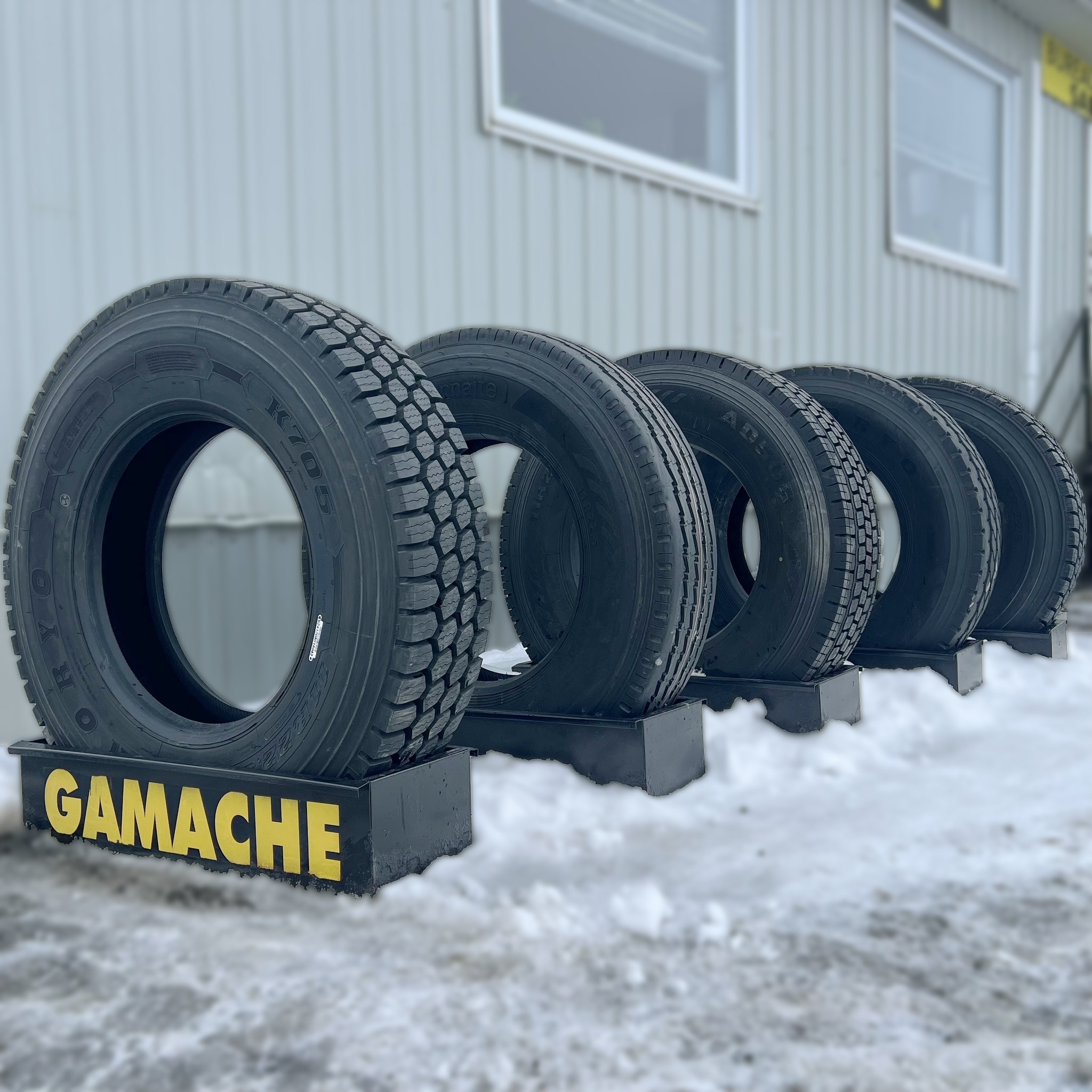
In Quebec, cold temperatures, snow, ice, road salt and temperature fluctuations put heavy truck tires to the test. Before winter, an inspection can help you check their pressure, wear, condition and compatibility with the vehicle.
Unlike passenger vehicles, heavy vehicles are among the exceptions to Quebec’s general requirement to use winter tires from December 1 to March 15. However, this exemption does not mean that just any tire can be used. Tires must comply with applicable safety standards, be compatible with the vehicle and be suitable for the conditions in which the vehicle is operated.
Here are the main points to check before hitting the road this winter.
Are winter tires mandatory on a heavy truck in Quebec?
No. In Quebec, the law provides certain exceptions to the requirement to use winter tires from December 1 to March 15, including for heavy vehicles and trailers.
In this context, a heavy vehicle includes a road vehicle with a gross vehicle weight rating (GVWR) of 4,500 kg or more.
However, this exemption does not mean that a heavy truck can be driven in the snow with tires in just any condition. Three things must be distinguished: the legal requirement to use winter tires, the mechanical compliance of the tires and the selection of tires suited to the operating conditions.
Heavy vehicle tires must comply with applicable standards regarding their condition, tread depth, pressure, size and installation.
Keep in mind: a legal exemption for heavy vehicles does not mean that tire selection and condition are unimportant in winter.
For current requirements, consult the official Quebec government information on winter tire requirements.
6 checks to perform on your heavy truck tires before cold weather
A proper heavy vehicle tire inspection should involve more than a quick look at the tread. Here are six points to check before and during the cold season.
1. Cold tire pressure and differences on the same axle
As temperatures drop, tire pressure can also decrease. It is therefore important to check it regularly throughout the winter.
Rather than applying a universal pressure value, follow the recommendations of the vehicle or tire manufacturer based on the load and intended use.
Quebec regulations also state that the variation in pressure between tires on the same axle must not exceed 10%. Tire pressure must not exceed the pressure indicated on the tire sidewall or fall below the value specified by the vehicle or tire manufacturer.
An unusual difference between two tires may also indicate an air leak or another issue that should be investigated.
2. Tread depth and irregular wear
Tread depth is an essential part of heavy truck tire maintenance.
In Quebec, the regulatory minimum is:
- 3.2 mm on a tire connected to the steering of a motor vehicle with a GVWR of 4,500 kg or more;
- 1.6 mm in other cases.
A tire is also non-compliant when a tread wear indicator comes into contact with the road surface.
Keep in mind that these values are legal minimums. They are not winter performance recommendations and do not guarantee that a tire will provide adequate traction in snow, ice or slush.
Measure tread depth at several points. Greater wear in the centre, on one shoulder or in specific areas may warrant a more thorough inspection.
3. Sidewalls, bulges, cuts and foreign objects
Visually inspect the tread and sidewalls of each tire.
Pay particular attention to:
- a cut or worn area exposing the reinforcing fabric or steel belt;
- a bulge or deformation;
- a significant crack;
- an object or foreign material that could cause air loss;
- visible separation of the tread or sidewall.
If damage is visible or there is any doubt about the integrity of the tire, have it evaluated before continuing to use it.
4. Valves, rims, wheel nuts and corrosion
Road salt, de-icing products, snow and moisture can make conditions around the wheels particularly demanding during a Quebec winter.
Check the condition of the valves and look for signs of damage or wear. Also inspect the rims, wheel nuts and other visible wheel components for significant corrosion, damage or other abnormalities.
Keep the wheels clean enough to allow a proper visual inspection. Accumulated snow, ice or de-icing products can hide certain problems.
5. Alignment and signs of a mechanical problem
A tire can also provide clues about the condition of other truck components.
Cupping, wear concentrated on one shoulder or wear mainly in the centre of the tread can be associated with various factors, including tire pressure, alignment, suspension or operating conditions.
These signs alone are not enough to establish a diagnosis. However, a more thorough inspection may help identify the cause before another tire is installed and prevent the same type of wear from recurring.
6. Dual tires
Dual tires on a heavy truck require special attention.
Under Quebec regulations, two dual tires must not touch each other, and the difference in their diameters must not exceed 13 mm.
Also check their compatibility. Tires of different sizes, construction types or series cannot be installed on the same axle or axle combination unless they are recognized as equivalent by the tire manufacturer.
Both tires should be visually inspected. The inner tire should not be overlooked simply because it is more difficult to access.
Choosing the right tire for its position and application
Not every tire on a heavy truck performs the same job. Before choosing a tire, consider its position on the vehicle, the load, the type of route and the conditions in which the truck will operate.
Steering axle
Tires connected to the steering system play an important role in vehicle steering and stability. Their size, load capacity and compatibility must meet the truck’s requirements.
In Quebec, a tire with a retreaded tread cannot be installed on an axle connected to the steering system of a vehicle with a GVWR of 4,500 kg or more, subject to the regulatory exception for a vehicle equipped with two steering axles.
Drive axles
On drive axles, tire selection should take into account the required traction, load, type of route and operating conditions.
A truck that makes frequent starts, works on challenging surfaces or regularly operates in snow may have different requirements from a truck used primarily on highways.
Trailer
For a trailer, check the tire size, load capacity, durability and compatibility with the intended application.
Although trailers are among the exceptions to the general winter tire requirement, their tires must still be compliant and in good condition.
Dual tires
In a dual-tire configuration, compatibility between the two tires is particularly important.
In addition to checking pressure, tread depth and overall condition, make sure the size, diameter and construction type comply with the applicable requirements.
How to evaluate a used heavy truck tire
Buying a used heavy truck tire should involve more than simply finding the right size. Its condition, capacity, intended position and compatibility with the vehicle should also be considered.
Here are the main points to examine.
Size and compatibility
Start by checking the tire size and its compatibility with the truck.
A tire must not be smaller than the minimum size specified by the vehicle manufacturer unless it is recognized as equivalent by the tire manufacturer.
Load capacity and application
Two tires of the same size are not necessarily interchangeable.
Also check the load capacity, construction type and intended application. The tire must be suitable for the position where it will be installed and for the way the vehicle will be used.
Tread depth measured at several points
Do not rely on a single measurement.
Measure the tread depth at several points across the tread. This can help you identify irregular wear or significant differences between different areas of the tire.
Condition of the casing, bead and repairs
Carefully inspect the tread, sidewalls, casing and bead.
Look for cuts, deformations, separations, visible repairs and other abnormalities that could affect the use of the tire.
Any repair must comply with the tire manufacturer’s standards.
Manufacturing code
The markings on a tire can be used to identify when it was manufactured.
This information can be considered when evaluating a used tire, but age should not be assessed in isolation. Recommendations can vary depending on the manufacturer, tire type, history and operating conditions.
New, used or retreaded tire?
There is no single answer that applies to every position and every application.
A used tire may be suitable for certain applications when it meets the applicable requirements and is compatible with the vehicle. A retreaded tire may also be used in certain positions, but Quebec regulations include a restriction on the steering axle of vehicles with a GVWR of 4,500 kg or more, subject to the regulatory exception mentioned above.
When should a tire be repaired, repositioned or replaced?
The appropriate decision depends on the condition of the tire, the type of damage, its position on the truck and the manufacturer’s standards.
| Observation | Prudent action | Professional validation |
|---|---|---|
| Pressure differs from the other tires on the same axle | Check the pressure and monitor for possible air loss | Have the tire checked if the difference returns |
| Irregular wear | Measure the tread and compare it with the other tires | Check possible causes before simply replacing the tire |
| Cut, bulge or deformation | Do not assume the tire can continue to be used | Have its condition evaluated |
| Foreign object | Do not remove it without considering the risk of air loss | Have a professional determine whether the tire can be repaired |
| Dual tires that touch or differ in diameter by more than 13 mm | Correct the configuration | Confirm tire compatibility |
| Questionable existing repair | Carefully inspect the area | Confirm that the repair complies with the manufacturer’s standards |
| Tread depth below the regulatory minimum | Remove the tire from that application | Replace it with a compliant tire suited to the position |
A tire repair should never be improvised. It must comply with the applicable tire manufacturer standards and recommendations.
5-minute tire checklist for your fleet
A quick, regular inspection can help identify an abnormality or change in tire condition early.
For each truck, check:
- tire pressure;
- pressure differences on the same axle;
- tread depth;
- irregular wear;
- sidewalls, cuts and bulges;
- valves;
- dual tires and the space between them;
- visible condition of the rims and wheel nuts;
- foreign objects and other visible damage;
- required actions and follow-up.
For a more complete seasonal inspection, you can also prepare the rest of your heavy truck for winter and integrate tire checks into your preventive maintenance schedule.
Find used heavy truck tires at Gamache
Are you looking for heavy truck tires in Quebec to replace a worn tire or prepare your truck for winter conditions?
Centre du Camion Gamache offers an inventory of used heavy truck tires. Before making your choice, check not only the required size but also the tire’s position on the vehicle, load capacity, construction, condition and intended application.
Tires available at Gamache can vary as inventory changes. To see the sizes, brands and models currently available, check our online inventory directly rather than relying on previous availability.
Looking for a specific size or want to check current availability?
Contact our team to confirm the size and availability.
Frequently Asked Questions About Heavy Truck Tires in Winter
Are winter tires mandatory on a heavy truck in Quebec?
No. Heavy vehicles are among the exceptions to Quebec’s general winter tire requirement from December 1 to March 15. However, this exemption does not remove the obligation to comply with applicable mechanical standards or to use tires suited to the vehicle and its operating conditions.
What is the minimum tread depth for a heavy truck tire?
Quebec regulations require a minimum tread depth of 3.2 mm on a tire connected to the steering of a motor vehicle with a GVWR of 4,500 kg or more, and 1.6 mm in other cases. These are legal minimums, not a guarantee of winter performance.
How does cold weather affect heavy truck tire pressure?
A drop in temperature can lead to a decrease in tire pressure. Pressure should be checked according to the recommendations of the vehicle or tire manufacturer rather than using a universal value. In Quebec, the variation in pressure between tires on the same axle must not exceed 10%.
How should dual tires on a truck be checked?
Dual tires must not touch each other, and the difference in their diameters must not exceed 13 mm. Their pressure, size, construction and overall condition should also be checked.
Can a retreaded tire be installed on a steering axle?
Quebec regulations prohibit a tire with a retreaded tread on an axle connected to the steering system of a vehicle with a GVWR of 4,500 kg or more, subject to the exception provided for vehicles equipped with two steering axles.
What should you check before buying a used heavy truck tire?
Check the size, vehicle compatibility, load capacity, tread depth at several points, wear, sidewalls, casing, bead, visible repairs and manufacturing code.
What signs indicate that a tire should be inspected before continuing to drive?
A bulge, deformation, significant cut, exposed reinforcing fabric or steel belt, unexplained pressure loss, abnormal wear or certain foreign objects are all signs that the tire should be evaluated before it continues to be used.


